Last update: 06/09/2026;
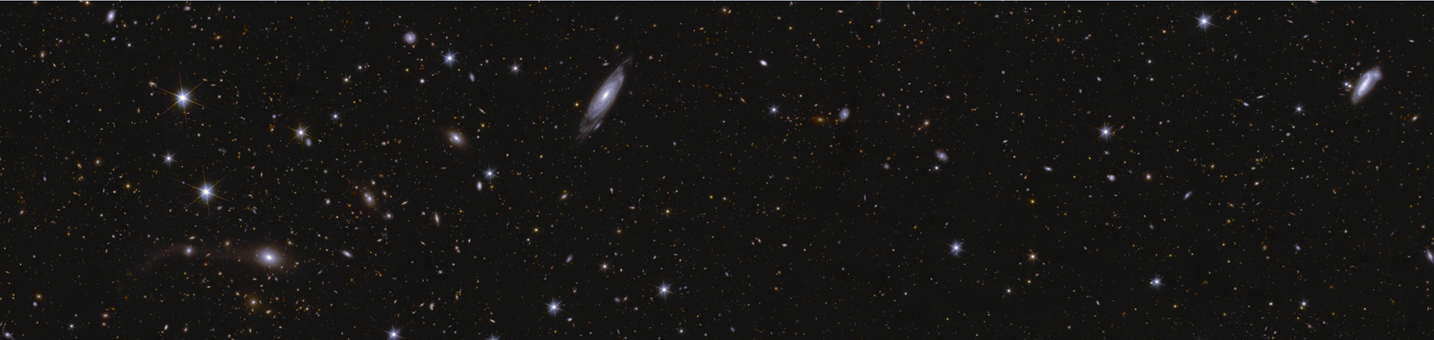
The goal of these four small lectures is to allow non-experts to reach a level of knowledge to appreciate and understand a cutting-edge astrophysics research topic.
To do so we will need to start from the basics of cosmology: I will present a historical overview of how the scientific community understood how galaxies form; why we observe that galaxies are not randomly placed in the sky but may be found in groups (so-called galaxy clusters); and why galaxy clusters emit radiation in various wavelengths (from optical to X-ray); we will see how scientists use this information to gain more and more information on the cosmology of our Universe.
We will also review the theoretical counterpart of observations: numerical simulations as a tool to interpret the large amount of observed data.
Finally, we will have all basic knowledge to appreciate and understand one particular cutting-edge scientific topic of how tracking the origin of so-called X-ray faint galaxy clusters can help advance future cosmology studies.
Recap of lecture I: historical overview
The first lecture of the series will review the basic ingredients from the Big Bang to the formation of galaxy clusters as well as why galaxies do cluster together in what we call galaxy clusters: they are the most massive and gravitationally bound structures in our Universe. They have gigantic radii of order of about 1 mega parsec (Mpc); they do emit both optical light and X-ray radiation; how to interpret these observations using theoretical models such as numerical simulations and how to extract information on the underlying cosmology governing our Universe by counting galaxy clusters in the sky.12
This is a very complicated topic and from a the point of view of a non-expert person, it may seem like magic how the astrophysics community reached such detailed knowledge by just observing it all from our planet Earth. However, astrophysicists did not build this huge knowledge budget in a linear and easy way: it took more than a century to slowly disentangle all the puzzling observations and possible solutions. Therefore the first lecture is structured with a historical approach: to understand how humanity managed to slowly progress on such a complex topic.
How does one observe galaxy clusters?
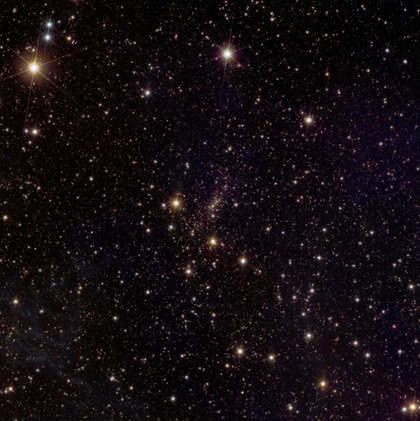
One may naively think that galaxies in our Universe are sparse and randomly distributed. However, take this recent image from the Euclid telescope where each dot here is a very distant galaxy: if we look at the central part of the image we can see that there the dots are not randomly placed, but they seem to be slightly clumped together. In fact, the observable Universe has a lot of galaxies that are in the form of groups and clusters.3
The study of these so-called galaxy clusters is fundamental for studying cosmology and within the last century we developed the theoretical framework to understand why they cluster (in short: because of gravitational attraction) and to numerically predict (on average) the cluster count expected for a given cosmological model. Finding these clusters is not an easy task, so the community developed sophisticated algorithms to recognize galaxy clusters in large images (e.g. AMICO by Bellagamba et al. 2017).4
Recap of lectures II and III: numerical simulations

To better interpret the images from telescopes as well as the large amount of data we extrapolate from them, scientists often use the so-called numerical simulations. The second lecture presents how these computer simulations work. Cosmological simulations begin with the hypothesys of a primordial and almost-homogeneous initial matter distribution of our Universe they then apply the laws of physics (mainly gravity) to allow for the tiny fluctuations to grow as gravity make them attract nearby materials and make them denser and denser. These simulations need a resolution good enough to resolve the very center of galaxy cluster cores (0.01-0.02 Mpc) and yet to cover volumes of cosmological scales at least 300-400 Mpc.5
To understand how challending these numbers are, between 0.01Mpc and 400Mpc, they are separated by number of almost 5 zeros: this comparable to the size of a single person in a soccer stadium or the duration of a single day in the time window of 270 years. To be able to simulate these extremely challenging resolution values, these simulations need huge memory and CPU requirements. They need to run on hundreds of computers working in parallel in the so-called computing clusters (most modern ones require hundreds of TB of RAM and physical storage)
The image here above is produced by one of the most important cosmological simulations ever produced, the so-called Millennium simulations produced in the early 2000s by Volker Springel and the Virgo Consortium, which were impressively large for those years: It follows the evolution of 10 billion particles (each with its 3D array of positions and velocities). Their intial positions and velocities comes from a nearly homogeneous grid (with a small displacement to distribute points according to a supposedly initial power spectrum as measured from the cosmic microwave background, CMB observations) and then evolved with newtonian gravity up to the current age of the Universe.
The results of these simulations show the formation of the so-called cosmic web: although the matter in the Universe started as homogeneous, as the Universe evolves, at scales below 50-100 Mpc it becomes more and more inhomogeneous thanks to gravity: it has voids, walls, and filaments, whose knots are the haloes that host the most massive galaxy clusters.6
Let's have an example on how simulations could be practically used to better interpret observations. The average matter density of our Universe has is not known with very high precision, as different observational surveys recover relatively different values ( see report from the Dark Energy Spectroscopic Instrument, DESI). To solve this issue one could execute a lot of numerical simulations, each hypothesizing a different average matter density of our Universe. Then one would analyse the results of the simulations in search for significant differences between the simulations (e.g. simulations performed with different cosmological parameters could result in observing fewer or more galaxy clusters).7
To interpret better these discrepancies one needs simulations that are able to reproduce extremely well the stellar and gas distribution inside galaxy clusters, so to predict respectively their optical and X-ray emission. Therefore the third lecture reviews how numerical simulations can account for gas that forms stars, stars that can explode and enrich the surrounding gas with new elements, how simulation techniques model the formation of supermassive black holes and how they model the powerful jets that they can emit.8
Recap of lecture IV: X-ray faint galaxy clusters
Finally, the fourth lecture investigates a cutting-edge topic in astrophysics: a small piece of the much bigger puzzle of constraining the cosmology of our Universe. In particular we will examine why the X-ray emission of some galaxy clusters is very faint (as published in Ragagnin et al. 2022).9
This is important because cluster number counts are difficult and observational studies have to properly model the possible missing X-ray faint objects. Therefore it is also important to know what kind of objects they are potentially missing.
Numerical simulations are a wonderful tool to solve these problems: they start from a homogeneous matter distribution and, as the computer simulation proceed, we "magically" find filaments and cluster forming thanks to the fact that they grow by attracting nearby matter. Inside these "digital twins" of our Universes, we can search for clusters and dissect their gas and stellar components: we can track them in time or re-simulate them with different physics to understand the imprint of a specific physcial mechanism galaxy cluster properties (e.g. we could re-simulate a cluster with or without allowing for the formation of supermassive blackholes and see how this impact the sourronding gas) The analyses on simulated data show that at least in our simulations X-ray faint clusters tend to be old.
Yes, it makes sense to talk about "the age" of a galaxy cluster, and it can be young or old depending on how many Gyrs ago they formed: smaller clusters move in the filaments and flow into the near knots, often "crashing" one into each other, thus merging together and becoming a newborn, more massive galaxy cluster.
There is a compelling hypothesis for X-ray faint haloes to be older: what if on old galaxy clusters a central black hole (on average) depleted the cluster of gas? While a black hole is negligibly tiny compared to a galaxy cluster, the gas that fall towards the black hole, contrary to popular expectation, do not necessarely enter it can get ejected from the galaxy cluster itself.10
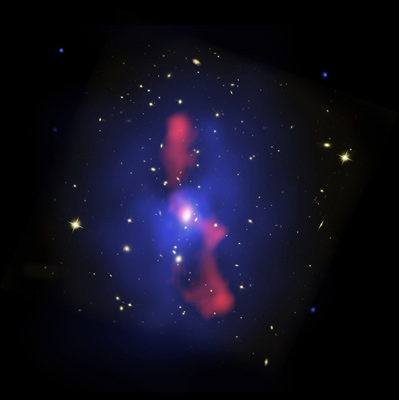
The image here on the left is an overlay of various galaxy cluster observations of visible light from the Hubble Telescope (the galaxy cluster is so distant that each yellow dot is a galaxy like our Milky Way), and X-ray from Chandra telescope (in red-blue), see how the gigantic red jet can be so huge that it can cover the distance that is so long that it can even surpass the spatial separation of various galaxies: as it starts from the center of the cluster, there are situations like the one in the picture where it can reach the very end of it. That is how powerful supermassive black hole jets can be.11
Simulations also hint that old galaxy clusters tend to be morphologically more round as opposed to young clusters (they just formed and it takes time for the gas to thermalise). In conclusion, characterising the origin of X-ray faint galaxy clusters can help observational studies to better model these poorly resolved or missing objects.
Lectures
(work in progress)
- From the Big Bang to galaxy clusters: a historical overview
- Numerical simulations as a counterpart to interpret observations
- Simulating star formation and black hole physics: hydrodynamic simulations
- Why are some X-ray cluster faint?
-
The thermal X-ray emission from the hot intracluster gas was established as bremsstrahlung radiation from a diffuse, hot plasma; see Sarazin (1986) for the classic review. ↩
-
The most precise measurement of the cosmic average matter density from the cosmic microwave background comes from Planck Collaboration (2020) ↩
-
Modelling black hole growth and its associated feedback in cosmological simulations is reviewed, e.g., in Di Matteo Springel & Hernquist 2005, Hirschmann et al. (2014) ↩
-
Earlier evidence reported by Andreon & Moretti (2011), or Andreon et al. (2019). ↩
-
The giant cavities and shock fronts driven by the AGN outburst in the cluster MS0735.6+7421 shown here were first analysed by McNamara et al. (2005). ↩