🚧Work in progress!🚧
^^ go back to parent lecture ^^
The Observable Universe has a radius of ~12Gpc. From cosmological principles we assume universe at this scale is homogeneus. However, as we zoom into it, we see clumps of matter, filaments, and walls that surround voids. Here above we see a slice from the famous Millennium Run numerical simulation. The slice here is "only" 1-1.5Gpc, and yet we can see the matter distribution is still pretty homogeneus altought we can spot filaments and voids. Zoom in (with mouse or mobile phone) and you will see that in the knots of these filaments there are a lot of small dots. These dots correspond to the haloes that hosts nowadays galaxies. As you can see galaxies are not just randomly distributed in the sky, they are clustered together in what it looks like to be clusters of galaxies
As an example, our Milky Way, together with its neighbours (Andromeda, ecc) we are all clustered together in the Laniakea supercluster. The Universe from there is made of clusters of galaxies, filaments of galaxies falls into these clusters, and void region. This is extremely important because our cosmology models (inspected with the use of simulations) will make prediction on the amount of galaxies and galaxy cluster (naively, a cosmological model with a large matter budget will also predict more galaxies).
Why and how cosmologists observe galaxy clusters?
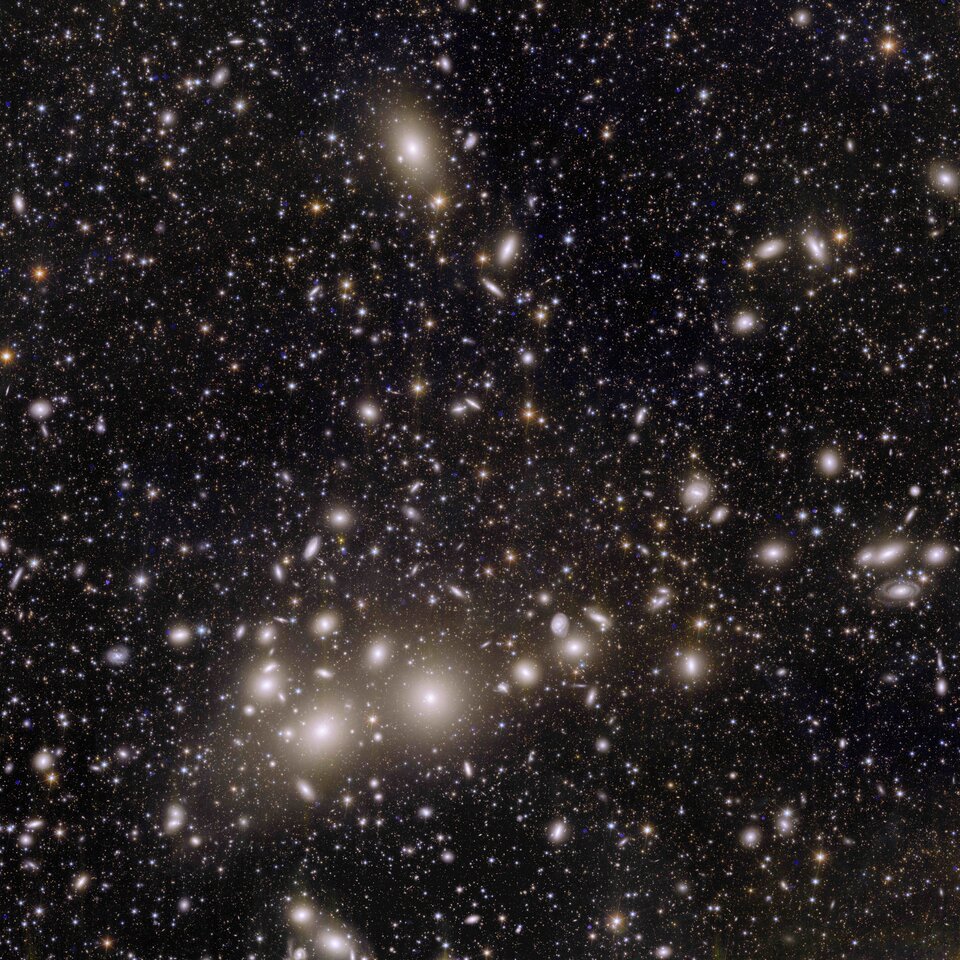
So, telescopes are scanning the universe to map its matter distribution. And among the various ways, one can test the cosmology models by comparing the clustering or galaxies (or even cluster of galaxies) from observations to theory. This is much more easy said to done. For instance how is a telescope going to "measure" a galaxy cluster? Well, it depends on the type of telescope: an optical one so with cameras that are CCD is going to see the optical emission of galaxies so the one from the stars within it, in the same way you can take a picutre of the sun, you can also take a picture of a far a way galaxy whose luminosity is given by the 100 thousand million stars of a far a way galaxy. Other ways on the other hand do measure the X-ray emission of the gas inside the galaxy clusters. See the image on the left of a cluster of galaxies captured by the telescope Euclid. This cluster is far enough away that all these shaded blobs are galaxies and the stars are so dense and high in number that from a distance we see a shaded gradient, and they are clustered together in a galaxy cluster.
Yes, because there is gas inside galaxy clusters and it is hot, and, by a phenomen called Bremsstrahlung. Where does the gas come from? Well, in the origin, after the Big Bang nucleosynthesi There were mainly gas. Now, you may think the gas should have cooled down already after 13Gyr as is the age of the Universe! But, since the gas is falling in the core of these galaxy clusters it is heating by friction and it gets extremely hot (107K!) this is so hot it emits in X-ray. Thanks to this emission X-ray telescopes as XMM, Chandra, or eROSITA can scan the sky for X-ray emission and identify clusters of galaxy out there.